Nobody appears to have this fully figured out yet, and Google is evolving fast, the rules keep shifting. But what we do know is enough to pay attention to. For 25 years, Google Search pretty much worked the same way. You type something, you get a list of links, you click one. But this is quickly becoming archaic.
At Google I/O in May 2026, Google announced what it called the biggest change to the search box ever. The list of links is still there, but it’s no longer the main event. Google now tries to answer your question directly, pulling from sources across the web and presenting the result as its own response. AI-generated overviews now appear on roughly half of all Google searches.
The problem for websites
There was an unspoken deal between Google and websites for as long as I can remember. You create the content, Google sends people to it. Now, when Google’s AI answers a question directly, it pulls from your website and presents the answer as its own. The link that used to bring someone to your site gets buried, footnoted, or dropped entirely. Your content gets used, and you might not get the visit.
This is the whole reason answer engine optimisation (AEO) has become a thing. The goal isn’t just to rank anymore. It’s to be the source the AI draws from, to get your brand mentioned by name inside the response itself.
Turns out the AI conversation has a VIP section
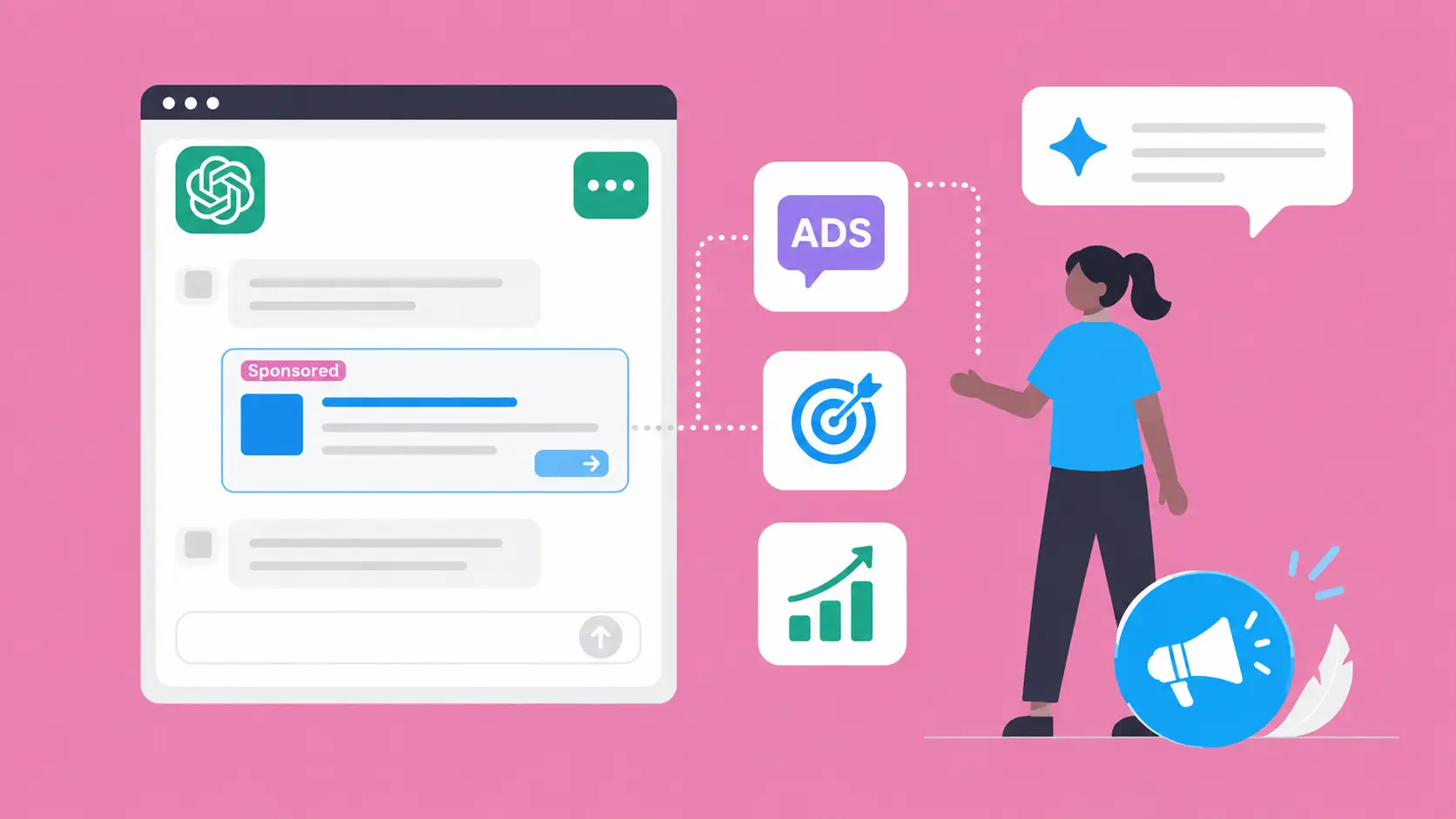
The day after Google I/O, at a separate event for advertisers, Google showed what ads look like inside AI Search. It’s a different model to what came before. The old model isn’t going away. Bid on keywords, your ad sits above or beside the results, clearly labelled. That still exists.
But Google has introduced new formats that sit inside the AI response itself:
Conversational Discovery Ads appear inside AI Mode answers. A sponsored result gets folded into the response for detailed, exploratory queries.
Highlighted Answers show up when AI generates a recommendation list. A paid entry sits alongside the organic picks, same format, labelled as sponsored.
AI-powered Shopping Ads are built for bigger purchase decisions. Gemini writes a custom explanation of why a product suits the user. It reads like a recommendation.
Business Agent for Leads puts a chatbot inside the ad itself. Users have a conversation with an AI trained on the advertiser’s website rather than filling out a form.
Worth noting: the AI assembles all of this dynamically. The ad you set up is not exactly what the user sees.
Setting up a Performance Max campaign: what to actually look for
If you decide to run a Google Ads campaign, the first decision is which campaign type to use, and it’s worth understanding the difference before you start.
AI Max is a Search campaign feature. It layers AI-assisted matching and asset generation onto a traditional Search campaign where you still control your keywords and ad structure. If you want that balance of control with automation, set up a Search campaign and you’ll see AI Max as a distinct step in the setup flow.
Performance Max is a different beast entirely. You’re handing Google almost full control across all placements — Search, YouTube, Display, Gmail, and Maps — from day one. There are no keywords to manage. Google’s AI decides who sees your ads, where, and when, based on your budget, your creative assets, and whatever conversion signals it can gather. It’s the more automated option, and for a new account with no conversion history it needs time to learn before it performs well.
If you go the Performance Max route, two settings are worth understanding before you go live. Both are found in the same place: open your campaign, go to Settings, scroll to the bottom, and click Show more settings.
Final URL Expansion allows Google to send people to pages on your site other than your chosen landing page if it decides another page is more relevant. It also rewrites your ad headline in real time to match. On a small budget with no conversion data yet, this can send paid clicks to pages that don’t convert. Use the URL exclusions to rule out anything you don’t want traffic landing on — your Privacy Policy, Terms of Service, and blog posts can each be excluded with a single rule.
Automatically Created Assets lets Google generate headlines from your site’s content. Worth leaving on, but check what it produces after a few days — auto-generated copy can be off-brand.
One broader note: Google’s own support chat inside the Ads interface is helpful but consistently optimistic about keeping everything switched on. An independent perspective will usually suggest being more conservative with a new account on a limited budget, until the campaign has enough conversion data to make good decisions on its own.
Who Google Ads with AI is actually useful for
Product-based businesses with a clear thing to sell are well suited to the new Shopping formats. The intent is obvious and the AI has something concrete to work with.
Trades and home services can benefit from how AI now reads commercial intent into informational questions. Someone asking “how do I know if my hot water system is failing?” isn’t explicitly searching for a plumber. But Google may read that as a job that needs doing and surface a relevant ad alongside the answer.
Businesses already running Performance Max are already using Google’s most automated campaign type, covering Search, YouTube, Display, Gmail, and Maps. AI Max is a separate option for advertisers who want AI-assisted matching and asset generation but prefer to keep control over their keywords and ad structure.
Higher-consideration purchases are a good fit for conversational AI search. If your customers research before committing, that research is increasingly happening inside AI Mode.
Who probably won’t see much benefit
Trust-based service businesses like therapists, accountants, and consultants tend to find clients through reputation and relationship. Someone asking “do I need a financial adviser?” isn’t going to click an ad in that moment. The journey is too long and personal for a paid placement to do much heavy lifting.
Very local or very niche operators rely on competitive bidding for the ad auction to work well. Low search volume plus thin competition means the economics may not stack up.
Anyone where Google Ads haven’t historically worked. The new formats are more sophisticated, but the same fundamental question applies: is your customer searching Google with purchase intent? If the answer was no before, it’s probably still no.
Paid and Organic are still two different things
Organic AEO is about being credible and structured enough that AI cites you for free. It works across all query types. It’s based on content quality, technical site health, and how widely your brand appears across the web.
Paid AI placements are Google Ads in a new form. They apply to commercial queries and require ongoing spend. They get you into AI responses faster, but typically only when buying intent is present.
Where it gets interesting is the overlap. The paid layer seems to work hardest for businesses that are already getting organic AI mentions. Appearing in both spots within the same response is a real advantage, if you can get there.
What to do with any of this
If you’re not running Google Ads: Think about whether your customers search with purchase intent. If you’re in a product, trade, or local service category, it’s worth looking at Performance Max. Talk to a Google Ads specialist about the setup.
If you’re already running Google Ads: Check what campaign types are active. Performance Max may already have you in the mix for AI Mode placements. Worth a conversation with whoever manages your campaigns.
Either way: The organic AEO fundamentals matter for everyone with a website. Content quality, technical health, and brand visibility all influence whether your business gets mentioned in AI responses. If you’re not sure where your site stands, an AEO health check is a practical place to start.
Nobody has all the answers yet
This landscape is genuinely unsettled. Over 45% of AI search citations change every couple of days. Platforms are updating constantly. What works today may look different in six months. What’s clear is that the businesses paying attention now are building a head start. And the ones assuming nothing has changed may find they’ve quietly gone missing from the conversation.
Further reading
Unlock next-level performance with AI Max for Search campaigns. Google’s own introduction to AI Max. Worth reading if you’re already running Google Ads or considering it.
Ad Infinitum — Matthias Ott — An independent take on what Google’s AI ad model actually means for the web. A bit pointed, but worth reading.